TL;DR:
Cloud backups don’t guarantee recovery. Many organizations can store data, but struggle to restore it in a usable, complete form when needed. The real gap is data recoverability. Read more…
Most companies these days rely on cloud data backup.
Data sits across platforms like Microsoft 365, Google Workspace, and Autodesk tools, and the assumption is: if something goes wrong, it can be restored.
But recovery is where things break.
- Over 60% of organizations believe they can recover data quickly, but only 35% of them can
- Industry estimates suggest backup restores can fail in a significant number of cases, sometimes up to 50%.
These numbers point to a gap: having cloud data backup solutions in place doesn’t mean your data is actually recoverable.
Why Backup Fails in Practice
Most backup strategies are built around storing data rather than storing and restoring it.
Data is copied, synced, and retained. But when recovery is needed, organizations often find that what was backed up isn’t easily usable in its original form.
This isn’t uncommon. Industry reports say:
- Human error and misconfiguration account for the majority of cloud data loss incidents
- 95% of cloud security failures are expected to be the customer’s fault (misconfigurations and mistakes)
Data loss is often operational, as at times files can be overwritten, folders can be deleted, or access permissions can be changed. And this is where many cloud data backup solutions may fall short.
The Missing Layer: Recoverability
Backing up data is only part of the equation. The real challenge is restoring it in a way that’s immediately usable.
In many cases, recovery becomes complex because:
- Folder structures may not be fully preserved
- Permissions and access settings can be difficult to restore accurately
- Data may require manual reorganization after recovery
- Restoration is limited to the original environment
As a result, even when data is recovered, it may not be operational. The real issue is whether data can be restored correctly and efficiently.
SaaS Platforms and the Recovery Gap
Many organizations rely on built-in protections within SaaS platforms. But these are not full backup solutions.
Most providers follow a shared responsibility model:
- They ensure platform availability
- Customers are responsible for data protection and recovery
Retention policies and recycle bins offer limited protection, but they are not designed for full recovery scenarios, especially after permanent deletion or structural changes.
This becomes critical in environments like construction, where data depends heavily on structure, versioning, and controlled access.
What True Recovery Requires
To close the gap between backup and recovery, organizations need recoverability by design.
That includes:
- Preserving folder hierarchy and organization
- Maintaining permissions and access controls
- Ensuring data is usable immediately after recovery
- Enabling recovery across different environments, not just the source
This is where Cloudsfer provides a clear advantage.
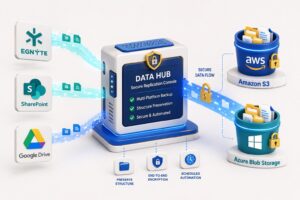
Cloudsfer focuses on ensuring that data is not just backed up, but fully recoverable and portable:
- Data can be backed up independently of the original environment.
- Folder structures and permissions are preserved during transfer and recovery
- Data can be restored to platforms or environments
This flexibility is especially valuable in scenarios such as platform migrations, project archiving, and managing construction data across Autodesk environments.
Book a free demo for your data backup
Closing the Gap
The gap between backup and recovery shows up in day-to-day operations. Organizations continue to invest in cloud data backup solutions, but when something actually goes wrong, recovery is what really matters.
Because in that moment, the question isn’t whether a backup exists, but rather if the data can be restored in a way that actually works.