TL;DR
Most organizations own their data, but ownership and control aren’t the same thing. As businesses rely on more cloud services and SaaS applications, it’s worth asking whether backup data can be accessed, moved, and restored independently when business needs change. Read more…
Most businesses assume they own their data.
After all, they created it, manage it, and rely on it every day. But as businesses continue to adopt cloud services, a more important question is emerging: who actually controls the backup data?
Yes, you probably own your backup data. But if you can’t access it, move it, or restore it without depending on your backup provider, ownership alone won’t help when it matters most.
Today, businesses use an average of 130 SaaS applications. As data becomes distributed across cloud platforms, backup systems, and storage providers, questions around data ownership, data portability, and long-term access become increasingly important.
In many cases, businesses focus on whether their data is backed up. Far fewer stop to consider where those backups are stored, who controls them, and what happens if they need to move, restore, or recover that data in the future.
This distinction between ownership and control is becoming a critical part of cloud backup and SaaS backup strategies.
Data Ownership vs. Data Control
Imagine an organization that stores years of business information across multiple cloud platforms. The data is backed up, recovery processes are in place, and everything appears protected.
Then something changes. A migration project begins. A vendor relationship shifts. Suddenly, questions start to surface that nobody had to ask before:
- Where is the backup data actually stored?
- Can it be exported without restrictions?
- Can it be restored to a different environment?
- How difficult would it be to move it elsewhere?
The answers to these questions often determine how much control a company truly has over its backup data.
In most cases, companies do own their backup data. The more important question is whether they can access it, move it, and restore it independently of the platform managing it.
Ownership may be defined in a contract, but control is determined by how easily data can be used when business needs change. Whether it’s a migration project, a new compliance requirement, or a decision to switch providers, companies should be confident that their backup data remains accessible and portable.
Why Data Portability Matters
Data portability is the ability to move data from one environment to another while maintaining its usability, structure, and integrity.
For many companies, this capability only becomes important when something changes. A company may decide to migrate platforms. An acquisition may require consolidating systems. Or an organization may simply want the flexibility to avoid becoming dependent on a single vendor ecosystem.
This concern is growing alongside SaaS adoption itself. Every application generates and stores business-critical data, often with its own policies around access, export, and long-term retention.
Without data portability, even a well-protected backup can become difficult to use outside the environment where it was created.
The Questions Every Business Should Ask
When evaluating a backup solution, businesses often focus on retention periods, storage capacity, and recovery capabilities. Those factors matter, but they’re not the only ones that should drive the decision.
For example, a company may decide to migrate platforms, consolidate systems after an acquisition, or change backup providers entirely. In situations like these, the following questions become important:
- Where will backup data be stored?
- Who controls access to the backup data?
- Can data be restored to a different environment if needed?
- Can backup data be moved without losing structure, metadata, or permissions?
- How difficult would it be to leave the platform in the future?
These questions help evaluate not just whether a backup works, but how much control an organization actually retains over its own data.
What Cloud Backup Should Deliver
A cloud backup strategy should do more than create copies of files. Businesses should look for solutions that provide:
- Strong data protection across cloud environments
- Automated backup processes
- Reliable recovery capabilities
- Preservation of structure, metadata, and permissions
- Data portability across platforms
- Flexibility in where backup data is stored
When these capabilities work together, companies can gain something more valuable than a backup: confidence that their data remains accessible, recoverable, and under their own control.
How Cloudsfer Approaches Ownership
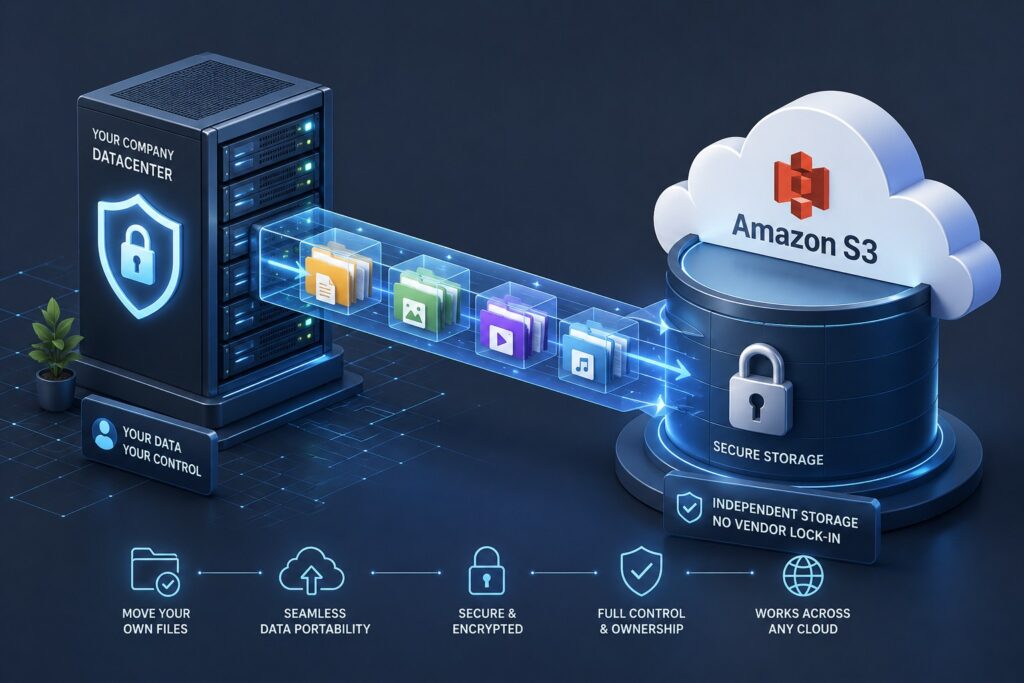
Cloudsfer’s backup solution is built around a BYOS — Bring Your Own Storage — model. Backup data goes directly to a destination the organization owns and controls, such as Amazon S3 or Azure Blob Storage.
This means companies maintain direct control over where their backup data is stored and how it is accessed. If priorities change, or if direct access to backups is needed without going through a vendor, that access already exists because the data was never anywhere else to begin with.
📌 Request a free backup demo
Final Thoughts
As SaaS adoption grows and data spreads across more platforms, the question of who controls that data matters more. A backup that exists but can’t be freely accessed, moved, or restored independently isn’t fully protecting the business.
The right question isn’t only “is our data backed up?” It’s “if we needed to walk away from our current backup provider tomorrow, could we take our data with us?”